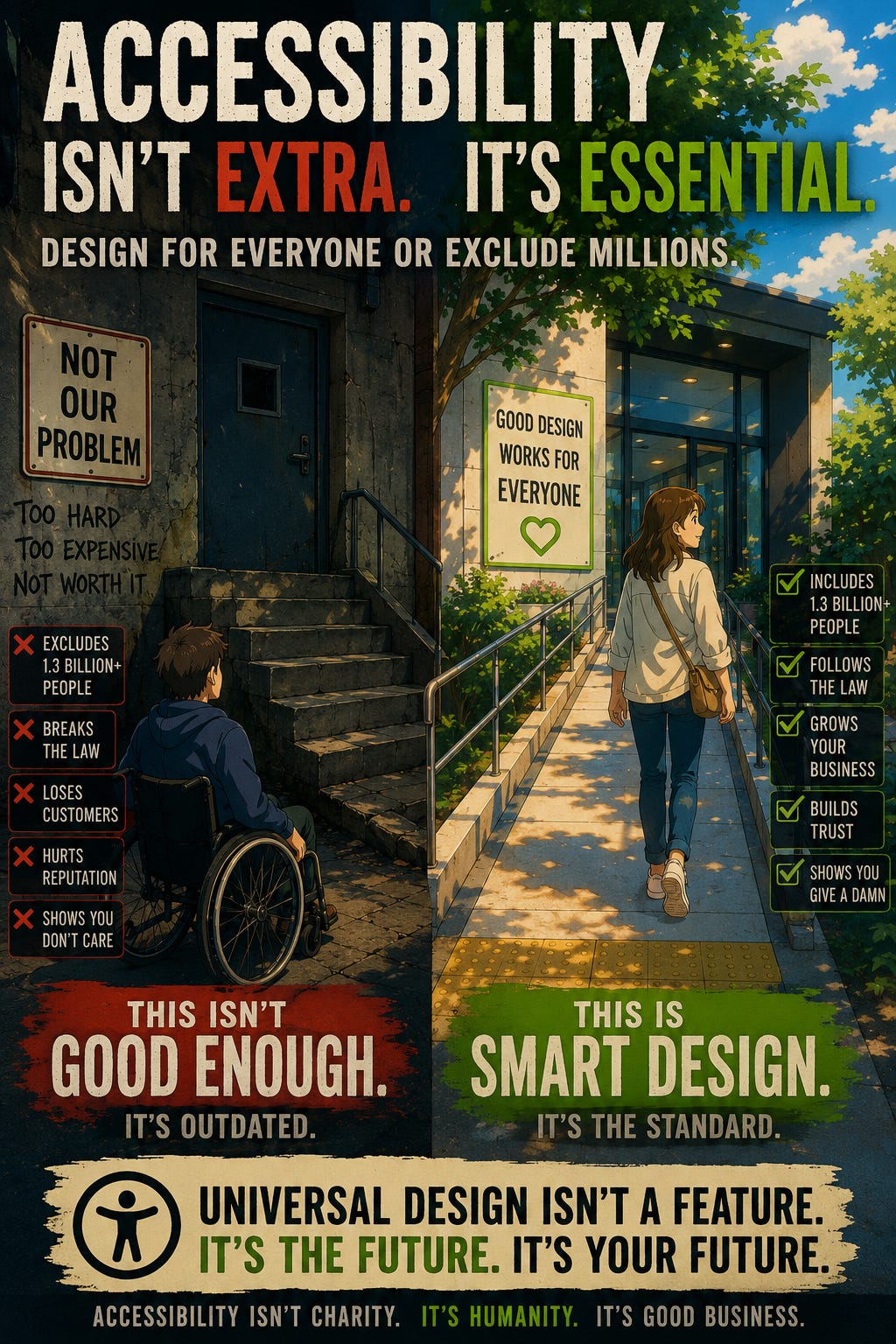
Everyone Thinks Accessibility Is for “Them.” That’s the Entire Problem.

Here’s a prediction.
At some point in your life, you’re going to become disabled.
Not necessarily forever.
Maybe you’ll break your arm.
Maybe you’ll develop arthritis.
Maybe you’ll get cataracts.
Maybe you’ll have a concussion.
Maybe you’ll simply get old.
Congratulations.
You’ve just become the target audience for accessibility.
The biggest misconception about accessibility is that it’s about accommodating a tiny minority of people.
It isn’t.
It’s about designing a world that acknowledges an inconvenient truth:
Human ability is temporary.
Every single one of us exists on a moving spectrum of capability.
Today you’re reading this on your phone while walking through an airport.
Tomorrow you might be trying to use that same phone one-handed because your kid fell off a bike and you’re carrying them to the car.
Accessibility suddenly matters.
Think about how many things you already use that were originally created for accessibility.
Curb cuts.
Closed captions.
Audiobooks.
Speech-to-text.
Voice assistants.
Automatic doors.
High-contrast displays.
Predictive text.
The list goes on.
The funny thing?
The people who benefit from these technologies the most aren’t always the people they were originally designed for.
Parents pushing strollers love curb cuts.
People at sports bars love captions.
Drivers love voice control.
Busy professionals love dictation.
Everyone loves automatic doors when their hands are full.
Accessibility has this fascinating habit of becoming invisible the moment everyone starts using it.
Then we stop calling it accessibility.
We just call it… good design.
Here’s where I lose people.
Every time accessibility comes up, someone inevitably asks:
“But what about the cost?”
That’s the wrong question.
The better question is:
What’s the cost of excluding millions of potential customers?
Over 1.3 billion people worldwide live with a significant disability.
That’s roughly one in six human beings.
Ignore them if you want.
Just don’t pretend that’s good business.
Accessibility isn’t charity.
It’s market expansion.
Imagine telling a restaurant owner:
“I’ve got an idea. Let’s intentionally make it harder for one out of every six people to eat here.”
They’d laugh you out of the building.
Do it on a website?
Somehow that’s considered a reasonable budget decision.
Here’s another spicy take.
The loudest critics of accessibility are often the people who benefit from it dozens of times a day without realizing it.
They enlarge text on their phone.
They use dark mode.
They dictate text messages.
They zoom into PDFs.
They ask Siri questions.
They watch TikToks with captions while their spouse is asleep.
Then they’ll turn around and tell you accessibility has gone too far.
That’s like walking through an automatic door while complaining that ramps are unnecessary.
“But people should just adapt.”
Really?
That’s an interesting philosophy.
Do you also think elevators should be removed because everyone should just climb stairs?
Should road signs disappear because drivers should memorize every street?
Should subtitles vanish because everyone should simply hear better?
Good design doesn’t demand more effort from humans.
It removes unnecessary effort.
That’s literally what engineering has always been.
Accessibility isn’t lowering standards.
It’s raising usability.
Those are opposites.
Universal design asks a deceptively simple question:
Can more people successfully use this?
Not because they’re entitled.
Because that’s the entire point of design.
If only one kind of person can use your product comfortably, your design isn’t exclusive.
It’s incomplete.
The irony is that accessibility has never really been about disability.
It’s about humanity.
It recognizes something our culture desperately wants to ignore:
None of us stay twenty-five forever.
Our vision changes.
Our hearing changes.
Our mobility changes.
Our memory changes.
Our circumstances change.
Accessibility isn’t designing for someone else.
It’s designing for your future self.
The version of you that doesn’t exist yet, but absolutely will.
You can call that “accommodation.”
I call it planning ahead.
The same way buying smoke detectors isn’t pessimism.
It’s simply acknowledging reality before reality introduces itself.